- Home
- All Kinds of Palms
- Indoor Palms
Types of Indoor Palm Trees - A Guide
Thinking about types of indoor palm trees for your home?
We'll show you the best palm tree types for your home's indoors. The ones you could try out, and how they'll be successful.
In our guide you'll see the top indoor palms, and tips for healthy growth. Plus oddities that help your indoor decor.
Feeling overwhelmed by palm tree problems or confusing information?
You’re not alone! At Mission: Palm Trees, we help everyday palm lovers grow, care for, identify & enjoy palms without baffling jargon or exhausting research.
We do the Authentic Research by cross-checking botanical data, while making palm tree info interesting & more fun to know.
Why Have Indoor Palm Trees?
What's more perfect than potted palms!
Different types of indoor palm trees will help purify the inside air. The leaves recycle the Carbon Dioxide (CO2) of your interior spaces. Turning it into fresh oxygen!
Because they exhale Oxygen (O2). The opposite of what your body does, by exhaling CO2. They'll Clean Your Indoor Air, too!
Remember that most types of indoor palms (if not all!) are sourced from a forest or swamp's understory. Meaning they grow beneath many taller trees, shrubs, and climbing vines.
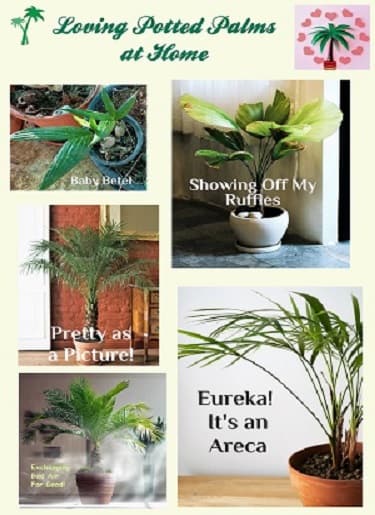
That's why they're not used to getting full sun, at all. So it's been found they can survive well indoors.
Whether for large spaces or small. We've organized this guide to help you figure out your own top indoor palm varieties. Which you'd like to choose.
But remember, Indoor palms are just one category within the many Different Kinds of Palm Trees, each suited to different environments and growing conditions.
What Types of Indoor Palm Trees are Best?
Think of indoor types of palm trees as being an ideal in your living space.
Naturally small palms are the choice. Because they grow to about 20ft/6m tall. But just because they're short palm trees, they're not necessarily suitable for growing indoors.
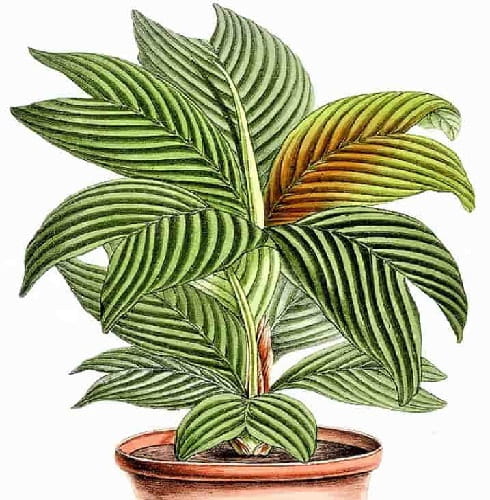 Liking This Stunner?!
Important Points for Types of Indoor Palms
Checklist for choosing a type of indoor palm tree:
- Is it known for doing well with low-light conditions?
- Will the indoor humidity level, especially in winter, be what it needs?
- Does it not live with excess water and full bright sun in its natural habitat?
- Does it not have irritating or hurtful Palm Plant Parts? Such as spines, allergenic oils, harmful fruits, etc.
Indoor conditions won't necessarily be suitable for some species, even if they're small. A suitable, well-cared-for indoor palm tree can live for ten years. Maybe even more.
Good to know because Buying Palm Trees is an investment of your time and money.
Mission: Palm Trees Update


-
Better Palm Tree Landscape Design - Avoid Mistakes
 Use palm tree landscape design ideas to choose the right spot, size, and spacing. Learn how to work around lawns, views, walkways, and power lines.

Guide to Different Types of Indoor Palm Trees
Which types of indoor palms are suitable for potting, then?
- Palm species that do well in low light conditions.
- Slow growing palms so they don't quickly overgrow their container.
We'll let you in on those which do well inside. Showing you their advantages (or not!), and other tips.
A Kentia Palm is an Easy Care for Indoors
Howea forsteriana is perfect for keeping indoors. Known to easily be long lived & tolerate indoor conditions.
- Probably best in a large space, as its leaf span reaches up to 6ft/2m long!
- Add some mulchy humus to soil for durable health.
- Needs medium amounts of regular watering & bright, but indirect light.
An excellent choice for bringing it outdoors in warmer months. If you do, choose a spot with partial shade. But full sunlight outdoors is fine if you're in a cooler climate.
Parlor Palm - One of the Best for Your Home
Also called Neanthe Bella, Chamaedorea elegans is an ideal palm tree in a pot.
Among slow growers, its small size makes it an excellent choice. It's the most popular among all types of indoor palms. Its contrasting stalks of flowers look stunning against the green fronds. Check its looks and ideal conditions:
- Elegantly arching green fronds. The feathery leaflets get about two feet long.
- Bright indirect sunlight and regular water helps maintain this attractive looking palm.
- One indoor Palm Problem precaution is its susceptibility to spider mites!
- Its natural habitat is Mexican & Central American rainforests. So added humus to soil is a good idea.
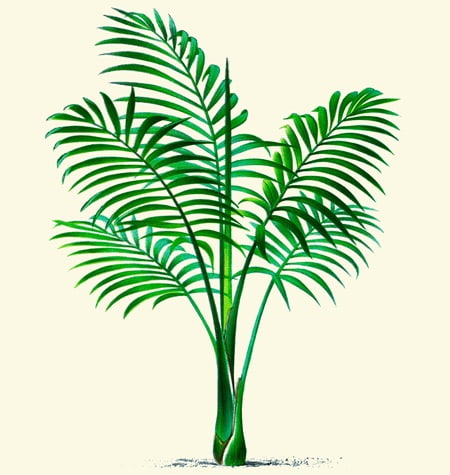 Parlor Palm illustrative painting from 1878.
Pygmy Date Palm Indoors Can Do Well - Easy Guide
Commonly referred to as the Miniature Date Palm or Robelini Palm.
Scientifically named Phoenix roebelenii. Popular choice for its fiber-matted trunk & feathery fronds. Its mature height is about 8ft/2.5m. Though more commonly seen outdoors, it does well indoors.
- In its natural habitat it likes mostly full sun. So near a western or southern window is good placement.
- No leaf production ever in growing seasons? It probably needs more light.
- How much water? Only just allow the soil to dry. That's the time to water again.
It's loved for planting in Landscaping Around Taller Palms. Or moving the pots there in the summer.
Phoenix roebelinii has a full crown of pinnate leaves. But caution is needed for avoiding the lowest fronds. Which are armed with leaflet spines.
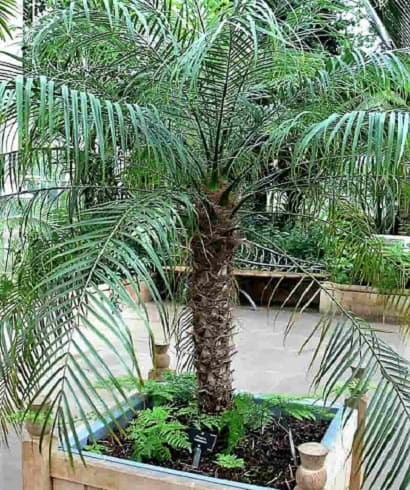 Waiting for you to take it home.
The Areca Palm - Your Best Indoor Care Guide
Dypsis lutescens has a stylish look with its crownshaft.
Among the most beautiful types of indoor palm plants. Also called the Butterfly Palm, Yellow Bamboo Palm & Golden Cane Palm.
 Vintage Ad Invite to Come See (And Buy!) Their Areca Palms
The Areca Palm gives instant tropical feel to any large room with its fast growth!
- Gets to heights of 15ft/4.6m. With a slender trunk.
- Ideal choice for airy rooms.
- TIP: Situate it near a large westerly or southerly window, with light filtering from sheer draperies.
- Well-draining soil is a must. Otherwise root rot could be a serious problem.
Precaution: Spider mites can attack, a common problem for it. Particularly with low humidity level in winter months.
Lady Palm - Easy Tip Guide for Beginning Indoor Gardens
Also nicknamed the Tall Lady Palm & even Bamboo Palm (as have many more species!!).
Rhapis excelsa is a clustering palm, growing multiple slender trunk stems. If they get too thick for the pot, they can be cut away.
It's perfection as a hardy plant. So probably the best type of indoor palm trees for beginners! Great low maintenance palm that's a survivor!
- Slow-growing, eventually reaches about 8ft/2.4m high.
- Large, glossy fan-shaped fronds.
- No watering problems, with medium needs & well-drained soil.
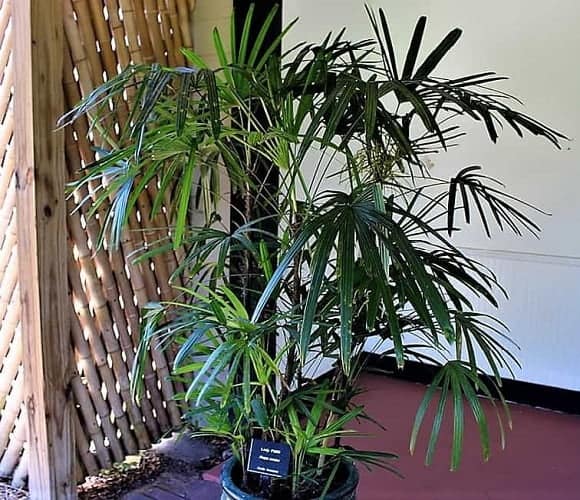 This Lady sits behind a screen at
the Coastal Georgia Botanical Gardens in Savannah, Georgia
Cataract Palm Care To Help Them Grow Best
The Chamaedorea cataractarum is also called Cat Palm & Cascade Palm.
In its natural habitat you'd find it along rivers & streams. So, it's a water lover.
- The trunk seems short. But actually it grows below the soil, or just above.
- Full height can get to 6ft/2m. At a medium pace.
- It likes bright light. Place it by a sunny window.
There are drawbacks for trying this for indoor spaces.
- Wants consistent humidity (humidifier may be needed). Even likes excess water & soggy roots!
- With tendencies for attack by spider mites.
- It grows additional trunks as a clustering palm, may be difficult to trim away correctly.
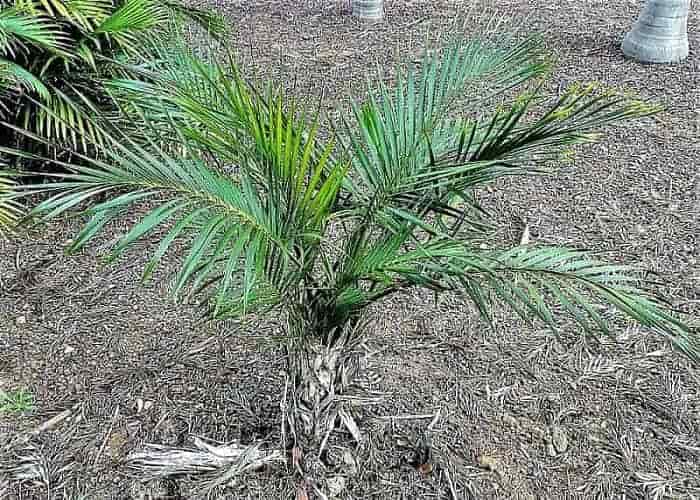 This small Cat Palm could fit in a nice container!
Hardy Bamboo Palms Brighten Up Any Home Garden
Chamaedorea microspadix - that "hardy" in its nickname is well earned!
If Harmed By Cold, it often regrows.
- Likes average watering for a moist soil, without totally drying out.
- As a clustering palm, prune trunks to avoid a crowded container.
- Does well with indirect sunlight, or even placement by the window on occasion.
An option is bringing it out to your patio in warm summer months.
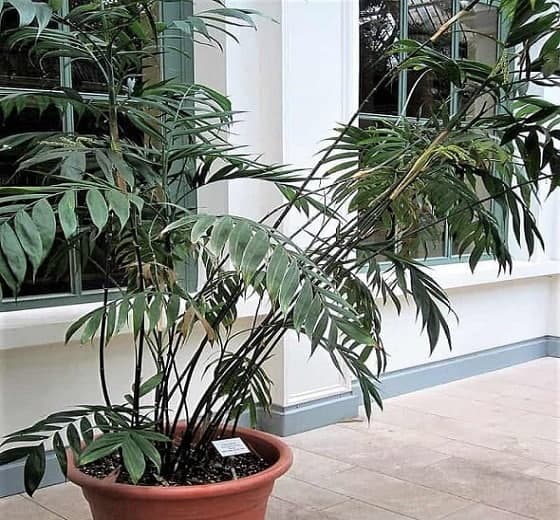 Going to "pot" at Palmengarten in Frankfurt, Germany
Another Bamboo Palm That's Fine Indoors
Chamaedorea seifrizii is also called the Bamboo Palm (that's confusing, yes!), but also Reed Palm.
Find its crownshaft among its usually dense foliage!
- Slender trunks for each clustering stem.
- Pruning Out Palm Stems carefully can beautify it.
- Grows pretty quickly with medium water quantities, and well-filtered sun. An east window setting will work.
- Feathery fronds grow leaflets of varying widths.
- One drawback is the inclination to get spider mites or pink rot during winter months!
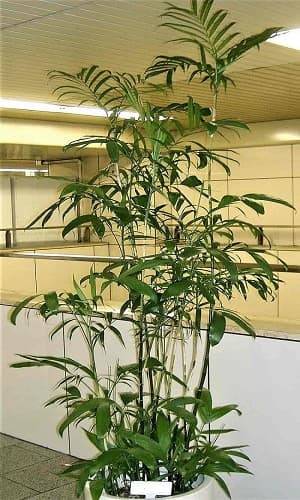 A delightful indoor potted specimen.
Guide a Metallic Palm Tree With Easy Care
No, not related to the American heavy metal band!☺️ Which was newly formed in 1981.
In fact, Chamaedorea metallica was accepted by the Royal Botanic Gardens as of 1966, and scientifically named earlier.
Also called Fishtail Palm & Miniature Fishtail Palm. With popularity among collectors, now rare in endemic south Mexican rainforests.
- Per its name, bluish green leaves have a metallic glow.
- Be sure it's adequately watered & drains well, avoiding fully dry soil.
- Partial shade is the way to go, at a lightly sun-filtered window.
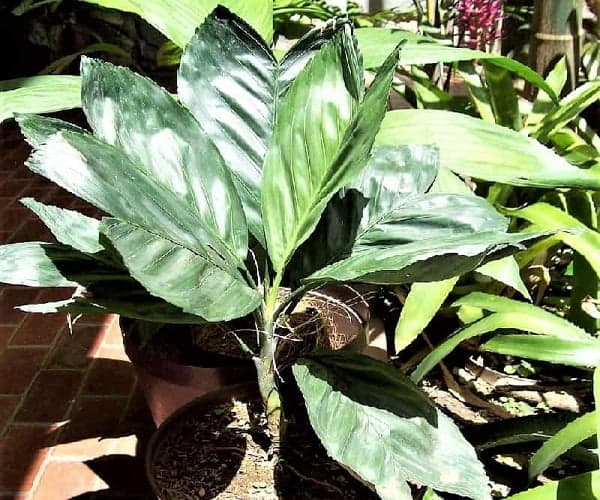 Metallic Palm, an admired looker in Caracas Botanical Garden, Venezuela.
Can the Chinese Fan Palm Grow Best Indoors?
Livistona chinensis is a popular choice for an indoor palm.
Particularly because it survives fine with indirect sunlight. Also called the Fountain Palm. But is it an excellent choice?
- Has a great tropical feel with beautiful dark-green fan-shaped fronds.
- Not often grown as indoor palms. They need large space & more light than most types of palms for inside. As outdoors in can attain 50ft/15m.
- To get the best out of it, give it a medium amount of water when soil dries. Give that soil with some humus.
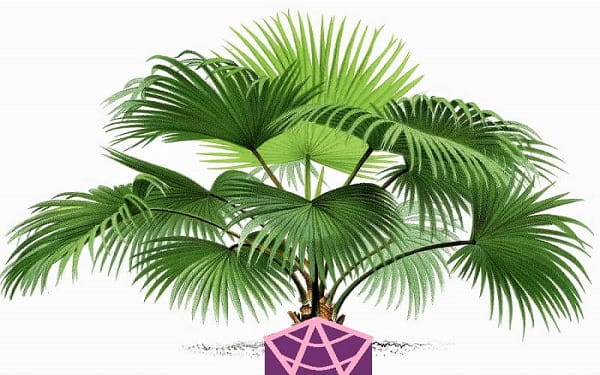 Livistonia chinensis: Artist's rendering as an indoor palm style.
Atherton Palm is Your Unique Potted Palm
Laccospadix australasica AKA Queensland Kentia.
Its origins are in northeastern Queensland rainforests. So partly shady spots and regular watering are best. Newly sprouting fronds, will surprise you with the lovely reddish color. Turning deep green as they mature.
You can easily Grow These From Seed. But They're Available in Pots, from about $60-US, and up.
 Its red fruit adds a nice contrast.
FAQ for Types of Indoor Palm Trees
Which indoor palm trees can tolerate low light conditions?
Which indoor palm trees can tolerate low light conditions?
There are quite a few! But the most dependable and successful are those that do best in low illumination, even dimly lit indoor rooms.
- You'll find many of these low-light indoor palms in the Chamaedorea genus:
- Chamaedorea cataractarum (Cat Palm)
- Chamaedorea elegans (Parlor Palm)
- Chamaedorea seifrizii (Bamboo Palm)
- Chamaedorea metallica (Metallic Palm)
- Howea forsteriana (Kentia Palm)
- Rhapis excelsa (Lady Palm)
There are even more, but do need a bit more sunlight. If you're starting out with using indoor palms in your home, those above are the best for being well-hardy in low light.
Are indoor palm trees safe for cats and dogs?
Are indoor palm trees safe for cats and dogs?
True palms (the family Arecaceae) are palm trees that are generally safe for pets.
You may be wondering that because some Palm Look-Alikes (cycads) are not safe for your dog and Not Safe for Your Cat. They have substances that cause much distress if animals eat the seeds, or other parts. Those cycads do not mix well with animals!
How often should you water indoor palm trees?
How often should you water indoor palm trees?
Palm Trees Kept Indoors for Growing in containers do need less water than an outdoor palm might need. Many are harmed because of Overwatering the Palm. Much more-so than underwatering.
You can use a water meter to see how dry the palm's soil is right now. But an easy way to test if you can water is to stick your pointer (index) finger right into the soil. As far down as you can easily go without disturbing the roots or trunk. If you don't feel any moisture, then you can water your palm.
If you do need to water that potted palm, be sure your container has drainage holes. Wait an hour or so, and then empty the water from the saucer below the container.
What's the difference between Majesty Palm and Cat Palm for indoor growing?
What's the difference between Majesty Palm and Cat Palm for indoor growing?
The Majesty Palm (Ravenea rivularis) and The Cat Palm (Chamaedorea cataractarum) differ most in light and indoor growth needs.
Both these palms are suitable for containers in your home. Which you would choose depends on where you'd like to place it. Here's the overview:
- Majesty Palms grow upward with a single trunk. They can reach ceiling height.
- While Cat Palms grow in clumps, spreading by growing more trunks. Barely reaching 6ft/1.8m tall, or much less.
LIGHT NEEDS
- Majesty needs more sunlight. Needing much more intense brightness where everything is clearly visible, like surgeons working in a operating room. Best at a sheer curtain-filtered west or south window.
- While the Cat tolerates much less lighting, like a room suitably lit to not stub your toe - but not lit enough for detail work like reading. Almost anywhere in a room with windows will work, but adjacent to a north or east window is an excellent choice.
WATER NEEDS
- The Majesty Palm likes a very humid environment. Its water needs are high, but ensure it drains well.
- The Cat Palm also needs a lot of water. But it tolerates soggy roots pretty well.
SOIL NEEDS
- The Cat does fine in any soil, but the Majesty does best with added humus.
Do indoor palm trees need direct sunlight?
Do indoor palm trees need direct sunlight?
No. Sunlight coming right through a clear glass window, shining directly on a potted palm is not advised. It can burn the fronds, and even lead to death.
- It's better to filter sunlight through sheer draperies.
- Or placed near a window, but not directly in sun's light.
- Those that need higher inside lighting can be placed aside west or east facing windows, but not directly in front.
There are palms that do quite well with interior lighting, those suited for less light than outdoors. Quite a few different types of indoor palm trees can work for you.
Alternate Types of Indoor Palm Trees
Types of Artificial Palm Trees for Indoors
Get the island paradise look in a cool, temperate climate. How?
With realistic artificial palm trees!
Get one of these types of indoor palm trees and you'll feel like you've already reached your vacation destination!
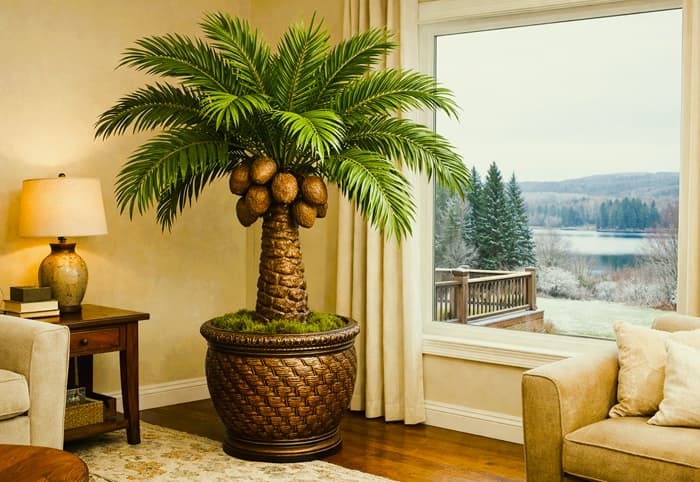 The only care a fake coconut palm needs: dusting & cleaning the fronds.
Realistic-looking, artificial palm trees are easier care than real indoor palms.
- Don't worry about its light requirements.
- Pop them anywhere it works in your home decor.
- They'll last for years to come.
And don't forget, these types of Indoor Palms Require Almost No Maintenance.
Mission: Palm Trees is made possible by readers like you! If you purchase via a link/ ad here, we may earn a small commission. At no added cost to you. Thanks for your support! Learn more>
Whether you’re looking for a tall palm for a grand entrance or an exotic palm plant for your living room. Check the selections we have for Artificial Palm Trees. Beauties to help create your tropical paradise inside your home!
Palm Tree Look-Alikes to Consider
Another option is choosing those Plants That Kinda Look Like Palms.
But they're not a true palm. Even though "palm" is often in their name! Like the Sago Palm, the Ponytail Palm & the Yucca Palm.
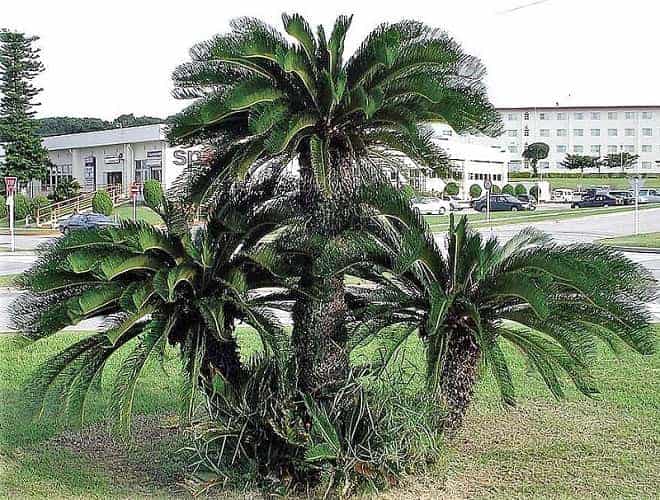 Not Actually a Palm, Even Though Called the Sago Palm.
Takeaways For Types Of Indoor Palm Trees
Indoor potted palms have benefits for your home.
Easily suited for growing in containers. Learn still more about caring for types of indoor palm trees with this Palm Plant Care Guide>.
You also have the typically hardy plants named as palms, but they're not!
If you're looking for palms that don't need much care, an artificial palm can do the trick. Many are realistic looking & can be the answer for you!
You might like these
Landscaping Around a Palm Tree that Looks Polished
Landscaping around a palm tree is easier with layered plants, edging, color, and climate-smart ideas that make one standout palm feel finished.
Where Do Palm Trees Grow? Maybe More Places Than You Thought!
Wondering where do palm trees grow? For sure it's the tropics & subtropics. They're more versatile than that, though. Even doable for temperate regions.
Landscaping With Palm Trees - Ideas & Top Tips!
Transform your yard when you discover our easy landscaping with palm trees ideas, perfect for any skill level. See simple designs that make a big impact.



About the Authors: Karen McGowan is the creator of MissionPalmTrees.com, and The Palm Species Navigator, along with her husband Bill. Where they share easy to read palm tree expertise gained from years of finding and studying palms in varied climates. So readers will know palms, and can avoid costly palm planting mistakes. Learn more.
We Love Arizona Where Palm Trees Grow & We Love Helping Others Appreciate Them Too!
Member of Local First Arizona - Supporting Local Businesses Wherever They Are!
Privacy Policy> | Terms/Conditions/CC Licenses> | Advertising Disclosure> | Contact Us>
Copyright © 2022 - MissionPalmTrees.com All Rights Reserved

Do Not Copy - No use is permitted without permission. Scraping the contents of MissionPalmTrees.com website for the purpose of AI (artificial intelligence) LLM (large language model) training is strictly forbidden. Mission: Palm Trees Name & Logo Registered in the U.S. State of Arizona
As an Amazon Affiliate we earn from qualifying purchases.
A Production of Picture Rocks Networking LLC
This site is protected under U.S. and International copyright laws.